


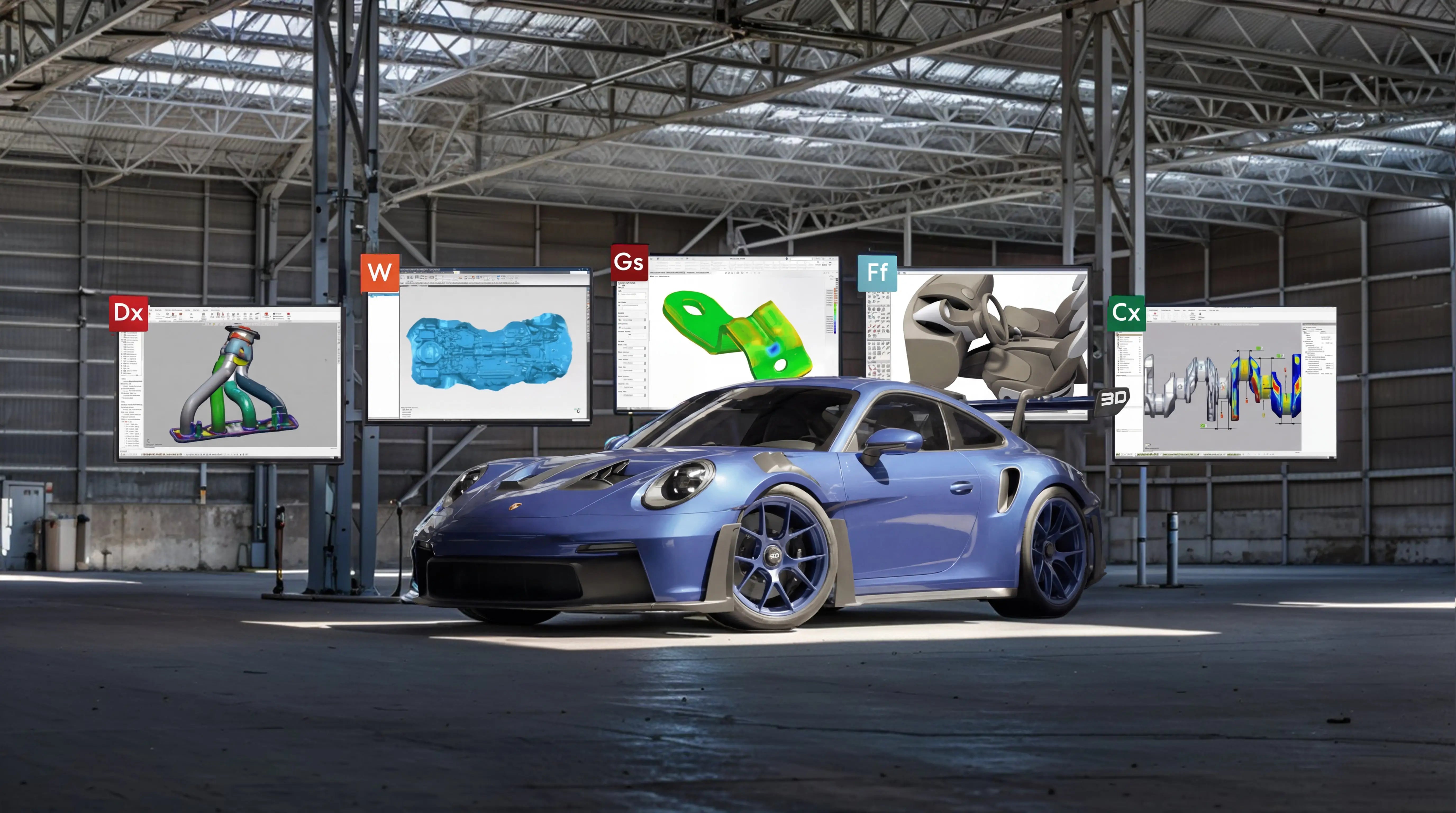


Handheld 3D Scanners: Professional & Industrial Digitisation
What are professional handheld 3D scanners? Professional handheld 3D scanners capture sub-millimetre geometric data and surface texture for reverse engineering, quality inspection, and metrology. These systems utilise blue laser grids, infrared VCSEL, or structured LED light to project patterns onto physical objects, calculating millions of data points per second. Modern architectures support marker-free tracking and wireless data transmission for unconstrained, large-scale part digitisation.
Precision Metrology on the Workshop Floor
Data integrity is the foundation of reverse engineering. When scanning mechanical components or automotive bodies, volumetric accuracy drift across large surfaces is a critical failure point. Professional handheld systems mitigate this through advanced optical tracking algorithms and multi-line laser arrays.
Blue laser configurations easily handle glossy, dark, or machined metal surfaces that traditionally require scanning spray. Single-line laser modes penetrate deep recesses and blind spots in complex engine blocks or turbine housings. Cross-line grids rapidly capture sweeping geometry. You get a complete digital twin, mapped directly into your CAD workflow.
Untethered Tracking and Modular Architectures
Physical freedom dictates scanning efficiency. Cable drag around a vehicle chassis or large industrial casting forces the operator to constantly reposition, increasing the risk of losing tracking alignment.
The industry is moving toward completely unconstrained operation. The new Shining 3D EinScan TRAK exemplifies this shift. It adopts a modular hardware architecture featuring a large-capacity battery and Wi-Fi 6 data transmission for instantaneous switching between wired tethering and true wireless operation. The EinScan TRAK innovates by offering marker-free scanning in both independent and tracked modes, utilising cross-line, parallel-line, and single-line blue lasers alongside full texture capture. Operators move around complex geometries without restrictive tethers or setup delays.
Laser vs. Structured Light
Matching the optical engine to the physical application determines mesh quality.
Blue Laser Systems (e.g., FreeScan series, EinScan TRAK): Designed for metrology-grade accuracy. They project a grid of laser lines to triangulate surface data. Highly resistant to ambient light interference. Ideal for shiny automotive parts, stamped sheet metal, and machined components requiring strict dimensional tolerances.
Structured Light & Infrared Systems (e.g., OptimScan series): Optimised for high-fidelity texture and organic geometry. They project a light pattern across the object, measuring the distortion to calculate depth. These systems are highly effective for cultural relic preservation, human body scanning, and aftermarket customisation where capturing precise colour and surface detail is as important as the underlying mesh.
Seamless CAD Integration
A scanner is only as effective as the mesh it generates. The hardware we support integrates directly with industry-standard scan-to-CAD software packages like Geomagic Design X and Quicksurface. Point clouds are instantly decimated, aligned, and converted into watertight watertight meshes or NURBS surfaces ready for manufacturing.


